CHRONOLOGICAL HISTORY
of the
LAKES CREEK WORKS
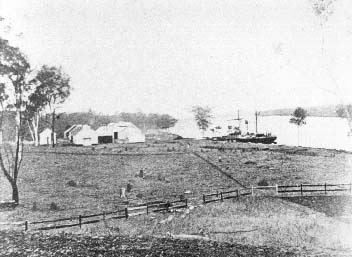
| The information to 1971 is taken from a publication issued to mark the centenary of Lakes Creek. The front cover citation reads “Compiled with valuable assistance from Mr G. W. Westacott, O.B.E., former Editor of the ‘Morning Bulletin’ and Miss A. Gill (Management Secretary) from records maintained by the late Mr A. H. Paterson.” |
| 1870 | An English Company under the name of The Central Queensland Meat Preserving Company decided to build a Meat Preserving Works on the Fitzroy River. A contract was let to Mr J. Ferguson, who was well known as a builder and constructed his own home in Rockhampton, now the Mater Hospital. |
| 1871 |
On the 26th June the Works at Lakes Creek opened with the slaughter of 11 bullocks, about 300 lbs. of meat from each being preserved. The cattle came from Waverley Station. Lakes Creek was named because of its association with a Captain Lake, whose trading vessel anchored off the mouth to take on supplies of fresh water. |
| 1874 | Cattle became scarce because of drought conditions and, at the same time, there was a glut of meat on the London Market, which created economic difficulties for preserving. In consequence, the Works was closed for financial reasons. |
| 1877 | Messrs. Whitehead & Coy, who formerly operated a Boiling Down Works at Laurel Bank 12 miles upstream from Rockhampton, purchased Lakes Creek and, with plant dismantled from their Works, set about enlarging the preserving works and building cottages for employees. |
| 1880 |
To this date preserving was carried on profitably. Prices paid for cattle were 11 shillings per cwt ¹ and full-fleeced wethers of 90 lbs were worth 9/6d. Unfortunately, losses elsewhere forced Whitehead into liquidation, At this stage The Central Queensland Meat Export Co.Ltd. was formed, consisting mainly of local shareholders. |
| 1881 | Preserving of meet continued. During this period successful shipments of frozen beef from the Argentine to Europe were being made, and this influenced the new Company decided to invest in a refrigeration plant. |
| 1882 |
H.
Ware, Foremen Butcher, wagered to "break and bone" a bullock of 750
lbs. dressed in 14 minutes or less. He had 57 seconds to spare. |
| 1883 |
Early in the morning of Thursday, l3th September, a fire broke out and destroyed a considerable portion of the Works. The refrigeration machinery and freezers were saved. Unfortunately, the fire robbed Lakes Creek of the honour of being the first Australian Works to ship frozen meat to England, The ship "FIODA" was a fortnight overdue at Lakes Creek, and arrived three days after the fire. |
| 1884 | Rebuilding took 11 months, but advantage was taken to enlarge and improve, particularly in the Tinsmiths and Preserving Departments. A staging wharf at Pt Alma was constructed. |
| 1885 | After a kill of 24,000 cattle and 21,000 sheep for the year, financial problems beset the Company, and it was forced into liquidation. |
| 1886 | The Works was purchased by a Melbourne Company - the directors being Andrew Rowan, George Fairbairn, and John Living. The Company decided to go in for freezing on behalf of cattle owners on a commission basis. |
| 1888 | Contract obtained for the delivery of 300 tons of Frozen Hindquarters to London. |
| 1890 |
Mr. Bertram, who had been Manager since 1880, resigned, and was succeeded by Mr. Alexander Paterson. It was during the latter's period of stewardship that the best results were obtained since establishment. Employment rose to 700, and the average annual kill was 50,000 cattle and 270,000 sheep. |
| 1899 |
Mr. Alexander Paterson resigned, and subsequently became a member of the first Federal Parliament. Messrs. T. S. Huggins and W. S. Lambe were appointed Office Manager and Works Manager respectively. A port at Broadmount, on the north bank of the Fitzroy River, was opened. |
| 1901 |
The Central Queensland Meat Export Co. was sold to a new Company formed in London by Sir Edward Montague Nelson. Sir Edward owned Works in New Zealand and had considerable experience in meat distribution. Mr. James Mackay (later Lord Inchape) joined the Board, and British India Steam Navigation Co. became a shareholder. George B. Hopper from Chicago was appointed Manager, and instituted new methods of slaughter, including the 4-lb. Hammer for stunning. The capacity of the Works was 300 cattle and 3,000 sheep daily. Mr. Hopper tried to diversify the Company’s interests by entering the Retail Butcher Shop business, Soap-Making, Bacon Curing, and a Butter Factory, but most of these enterprises failed. |
| 1911 | The Government decided to abandon Broadmount as a port and support Port Alma. |
| 1912 | A railway was opened to Port Alma |
| 1914 | During the War years the output of the Works was sold to the Australian Government, which had contracts with the British Government. |
| 1918 |
Mr W. A. Mackay was appointed manager. During the year, Rockhampton’s greatest recorded flood occurred. The works was affected but the machinery and refrigeration was maintained. Contact between departments was by boat. |
| 1922 | A glut on the meat market in London forced down prices, and the Federal Government granted a subsidy of 5/3d per l00, a bullock of 700 lbs. being worth less than £5. |
| 1923 | Mr. A. H. Paterson, son of Alexander Paterson, was appointed Manager, having joined the staff in 1891. |
| 1924 | The Works was leased to Union Cold Storage Company, but operations were not very successful. |
| 1926 | An
English Company, of which Lord Inchcape of P & 0, fame was Chairman, took
a lease of the Works for one year. 2
Overseas prices remained uneconomic and financial difficulties increased when the Bank refused to extend the overdraft. The Manager cabled the Downers in Latin the gladiatorial salutation of Roman times "We who are about to die salute". The answer came in the same dead language that they hoped that, “like Phoenix, we would rise again from our own ashes”. The ashes smoulderd for another 18 months. |
| 1927 | The Works remained closed and only three employees retained. |
| 1928 | The whole of the share issue of the Company was purchased by a syndicate, which included the late Sir William Angliss and F. J. Walker. The world-wide depression made operations unprofitable. |
| 1934 |
The Ottawa Agreement, which gave preferential treatment to Empire produce, brought about a favourable change and, as a result, Vestey Bros. purchased the whole of the Angliss Australian interests for £1,500,000, including Lakes Creek. Mr A. E. Moore was transferred from Brazil to become Works Manager. Modern chillers were erected, and the new owners organised the transport of chilled beef quarters to England on a regular basis. The first shipment left Port Alma in the "DORIC STAR" in October,1934. A large Cannery of three storeys was also constructed, and the Engine Room and Killing Floor enlarged. Killing capacity was increased from 500 to 700 head daily. The Vestey Organisation decided, as a matter of policy, to keep the Works open all the year round - the first export works outside the metropolitan area to do so This was to encourage cattlemen to market outside the seasonal pattern. The policy provided an incentive to cross-breeding and improved property control, thus assisting the chilled beef trade. The chilled beef trade increased from 1,292,830 lbs. in 1934 to 15,660,624 lbs. in 1939, with a corresponding reduction in frozen. Smallgoods and Ham and Bacon Departments commenced production. |
| 1939 | At the outbreak of World War II chilled beef shipments ceased and all beef was frozen and acquired by the Government. The daily kill was increased to 846 head daily. |
| 1940 | The Canning Department worked intensive shifts for the Armed Forces. 2,200 persons were employed during the period. |
| 1942 | The U.S, Army purchased supplies of Canned rations for the South-West Pacific area, and later frozen meat in boxes. |
| 1945 | The necessity to remove the bones from export beef during the War years to conserve shipping space influenced a trend in the production of Cuts of Beef ready for the butcher and wholesaler thus, boning became an important Feature of the industry. The cuts were shipped in stockinette and hessian bags. |
| 1946 | In conjunction with the Rockhampton Agricultural Society, the Works commenced staging its annual beef Carcase Competition and Critique at the end of the Annual Show. |
| 1947 |
Most of the production was shipped to the United Kingdom in frozen form under the terms of the 15-year Meat Agreement. Reconstruction of the main Freezer Block commenced. |
| 1953 | On the 9th, September Mr. A. H. Paterson, General Manager died at the age of 78 years, and he was succeeded by Mr. M. Hinchliff. |
| 1954 | A major flood isolated many sections of Rockhampton, including Lakes Creek. Meat supplies were maintained, but killing took place in the Abattoir surrounded by water: to a depth of two feet. |
| 1955 | The Works introduced a local abattoir service for local butchers. A record kill of 174,500 head was registered for the year, the daily kill being increased to 987 head daily. |
| 1957 | Shipments of Manufacturing Type Beef shipped to U.S.A. for the first time after the U.K. Government agreed to release Australia from certain provisions on the 15-year Meat Agreement. |
| 1959 |
The Federal Award for Females introduced in major export works, including Lakes Creek, superseding the State Award. The revival of the Chilled Beef trade with United Kingdom was attempted, with the commissioning of four Blue Star Line vessels to take the beef by the North-about route through Torres Straits and Suez. The first shipment left Port Alma by M.V."SCOTTISH STAR", now marooned in the Suez Canal. The "ROCKHAMPTON STAR" also called on her maiden voyage. |
| 1961 | Shipments of Chilled Beef suspended as uneconomic, while trade increased substantially with U.S.A. The road to Port Alma was opened. |
| 1962 | The installation of the Can-Pak on-the-rail beef dressing system was completed - the second in Queensland. This superseded the old "bed" system, when most of the skinning vas performed on the ground. The Federal Award for all Meatworkers was introduced. |
| 1963 | Major alterations to Boning Department, female packers working alongside boners and slicers (trimmers). New piece work system introduced. U.S.A. Authorities intimated to Australian Government that new hygiene procedures would have to be introduced in Abattoirs if Australian Meat was to be acceptable. The Federal Award, covering all meatworkers, was introduced. |
| 1964 | Plans announced to build two-storey Abattoir lock and new Rendering Department at Lakes Creek to replace existing structures. Also announced were plans for a 2,000-ton Cold Store at Port Alma. Total estimated cost in excess of $3,000,000. |
| 1965 |
Temporary loss of Export Licence as a result of visit by U.K. Veterinarian, Restored after three weeks' interruption while alterations made. 2 Conveyor system of Side Boning introduced. During transfer of operations from old Killing Floor to new Abattoir Block, temporary on-rail facilities constructed and two shifts operated. |
| 1966 | New Abattoir Block and Port Alma Cold Store brought into Operation in February. Hide Strippers, known as "Moscow Mules" used for first time. Agreement with Rockhampton Abattoir Board for killing of cattle for local butchers. |
| 1967 | Beef killing reached daily peak of 1033 head in July. |
| 1968 | U.S.A. introduced quota system, which restricted meat shipments to that country. |
| 1969 | The Australian Meat Board introduced Diversification Scheme to divert and develop meat exports to other countries and phase shipments to U.S.A. on an orderly basis. |
| 1970 | In November regular shipments of Chilled Beef Cuts in cartons were commenced. The cartons were stacked in containers for shipment via. Brisbane to Japan, The Company purchased land at Emerald for a possible meatworks site. |
| 1971 |
The first shipment of Chilled Cuts from Australia to the U.K, was made from Lakes Creek in February, the honour being shared with F. J. Walker & Sons of Sydney. Despite unforeseen delays, the meat arrived in excellent condition and was favourably commented upon. Further shipments are now being made. The Works received a licence for the export of Mutton to the U.S.A. The first Lot Fed Beef was slaughtered, the cattle coming from J.C. Mayne & Sons, “Wealwandangie", Springsure. The first direct container shipment of frozen beef for the East Coast of North America left Pt Alma on “COLUMBUS NEW ZEALAND” on the 13th June, 1971. |
| 25 June 1971 | The Centenary of Lakes Creek to the day (25th. June) is to be celebrated with a large barbecue at the Works for employees and families, a special Race Meeting at Callaghan Park, and an Official Dinner at the Leichhardt Hotel for graziers, Ministers of the Crown, and those closely associated with the Works in the past and at the present time. |
| 1973 | The processing of small stock at Lakes Creek ceases. |
| 1979 | Construction of the current freezer and load out building |
| 1981 | Construction of the current beef chiller and boning room building |
| 1983 | Production of small goods ceases |
| 1986 | Cannery closes, with operations transferred to Wagga. Can making plant continues operations. |
| 1991 | Can making plant closes. |
| 1992 | Lakes Creek purchased by Smorgon from the Angliss Group. |
| 1994 | In
July Consolidated Pastoral Company joined forces with the Tancred Family to
form Consolidated Meat Group Pty Ltd.
Works closes for annual shutdown in December. |
| 1995 |
The plant does not reopen after the annual shutdown. Employees paid off in March. CMG purchases the Lakes Creek plant, and commences production in July. |
| 1996 | Extensive upgrade of slaughter, boning, freezing and rendering facilities. |
| 1998 | Further upgrade of slaughter line, daily capacity increased to 1,500 head on a 10 hour shift. |
| 1999 | In July Consolidated Pastoral Co. assumed 100% ownership of CMG. Production increases to 2,000 head per day on two shifts. |
| 2000 | Upgrade of boning room packing systems, increased refrigeration capacity. |
|
Notes: 1 Cwt. is an abbreviation for hundredweight, 112 lbs [pounds], about 51 kg. 2 Some additional information which appeared in a works file copy of this history, but was not included in the published book, has been included. |